The journey from a raw musical idea to a polished, Grammy-winning recording is a complex alchemy of talent, creativity, and technology. While the artist’s soul and the songwriter’s craft form the foundation, the tools used to capture and shape these elements are the unsung heroes of the recording process. Winning a Grammy is a monumental achievement that signifies not just artistic brilliance but also technical mastery. A key component of this mastery lies in understanding and wielding the technology that defines modern music production. This article delves into the high-tech arsenal favored by Grammy-winning producers, exploring the hardware, software, and workflows that have become the industry standard for creating award-winning sound .
The Indispensable Audio Interface
At the heart of any modern studio, whether a sprawling commercial complex or a compact home setup, is the audio interface. This crucial piece of hardware serves as the bridge between the analog world of microphones and instruments and the digital domain of a computer. For countless Grammy-winning producers, one name stands above the rest: Universal Audio.
The Universal Audio Apollo series has become an industry standard, praised for its pristine sound quality, low-latency performance, and powerful onboard digital signal processing (DSP) . The DSP allows producers to run high-fidelity UAD plug-ins in real time without burdening their computer’s CPU. This feature is invaluable during tracking, as it enables musicians to record with effects like compression and reverb, monitoring their performance as if they were playing through a high-end analog studio setup with zero perceptible latency. Producer Daniel Nigro, who won the Grammy for Producer of the Year, has stated that Universal Audio’s Apollo interfaces and UAD plugins are necessary for every single song he works on . Similarly, Will Yip, a Grammy-winning producer and engineer, has used Apollos exclusively for 13 years, declaring he cannot make a record without one .
Producer and engineer Louis Bell, known for his work with Post Malone, demonstrates that while high-end interfaces are crucial, the workflow can be remarkably streamlined. Bell’s primary tools are a laptop running Pro Tools and FL Studio, a Universal Audio Apollo Twin Duo interface, and a Sony C-800G microphone . This efficient setup underscores that while a professional interface is non-negotiable, the modern producer can achieve world-class results with a focused and powerful, yet minimalist, approach.
The Golden Ears: Monitoring and Microphones
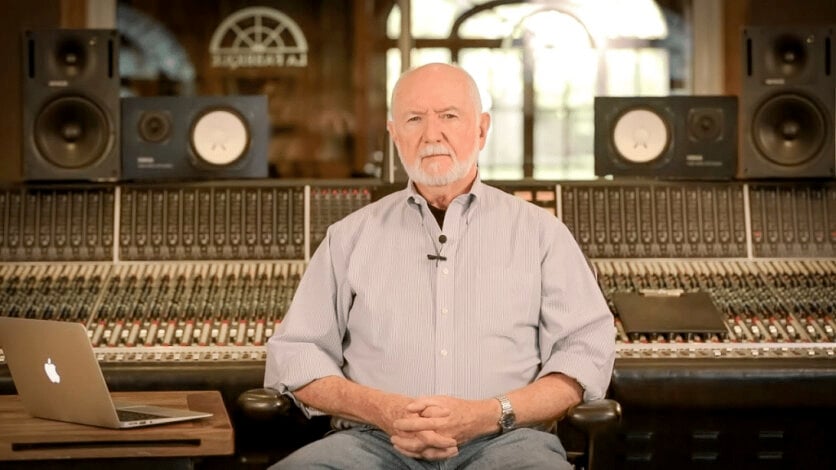
Creating a mix that translates well across all listening environments requires speakers and headphones that provide an accurate, uncolored representation of the audio. These are the producer’s “golden ears,” allowing them to make critical decisions about balance, EQ, and dynamics.
Studio Monitors and Headphones
Many top producers rely on renowned studio monitor brands. Louis Bell, for instance, uses Genelec 8351B nearfield monitors alongside the larger 1035A main monitors in his studio . He credits the 1035As for delivering crystal-clear mids and vocals, making him feel confident in his mixes. Will Yip is another producer with a strong preference for a specific monitor. He insists on Focal Trio6 monitors, going so far as to have them swapped into other studios when working on high-stakes records . Yip’s new Memory Music Studios is outfitted with Focal Trio6 ST6 monitors in all four control rooms, demonstrating his complete trust in these speakers.
In addition to monitors, accurate headphones are essential for critical listening and tracking. Will Yip also uses Focal Clear Mg Pro headphones exclusively for mixing, further solidifying his commitment to the brand . These precision tools allow producers to hear every nuance, error, and detail, ensuring the final product is pristine.
The Microphone Locker
The journey of sound begins with the microphone, and the choice of microphone is paramount in capturing the character and color of an instrument or voice. A producer’s microphone locker is often filled with iconic, high-end models, each with its own unique sonic signature.
The Neumann U 87 is arguably the most highly regarded microphone in the world. It’s a crown jewel for recording everything from vocals to guitar cabs, and for Keith “Ten4” Sorrells, it was his first microphone and remains a favorite for its energy and versatility .
Other classic mics frequently cited by top producers include:
-
Sony C-800G: As mentioned, this is Louis Bell’s go-to microphone, a staple for capturing the high-end detail needed in modern pop vocals .
-
Neumann U 47 FET: Keith “Ten4” Sorrells uses this microphone for guitar and kick drum duties, praising its low-end response for heavier music .
-
AKG D12: Also favored by Sorrells, this dynamic microphone is a classic choice for kick drums, providing a punchy and defined low end .
Shaping the Sound: Outboard Gear and the Analog Mystique
While digital audio workstations (DAWs) and plugins offer incredible power and convenience, many Grammy-winning producers still integrate analog outboard gear into their workflow to add warmth, depth, and character . This hardware, often based on vintage designs, can impart a sonic richness that is difficult to replicate entirely in the digital domain.
The Summing Mixer
One piece of outboard gear that has seen a resurgence in popularity is the analog summing mixer. Instead of mixing entirely within a DAW, producers route individual tracks or groups of tracks out of their interface, sum them through an analog unit, and bring the stereo result back in.
Keith “Ten4” Sorrells uses the Dangerous Music 2-BUS+ summing mixer for this very purpose. He notes that it provides significantly better separation and “space” in his mix compared to mixing entirely in the box. It helps him achieve clarity and dimension, especially when working with loud mixes . This “analog magic” is often cited as a key element in achieving a polished, professional, and highly competitive sound.
The Mixing Console
For a more traditional approach, vintage analog mixing consoles remain the heart of many world-class studios. Matt Ross-Spang, a Grammy-winning producer and engineer who embodies the spirit of classic recording, built his studio, Southern Grooves, around a vintage 1969 Spectra Sonics console . This console was sourced from the era and location where it was originally built, adding to the authentic, analog vibe of his space. Ross-Spang’s studio is designed to be a haven for live recording, favoring an environment where musicians can play together and hear each other naturally, much like the legendary studios of the 1950s and ’60s.
Essential Outboard Signal Processors
Outboard compressors and EQs are used to shape and polish sounds before they even hit the DAW. Common examples include:
-
The 1176 Classic Limiter: Famous for its fast attack and aggressive sound. Bill Putnam, a pioneer of modern recording, developed early versions of this circuit, and his legacy continues through Universal Audio, which produces hardware and software versions .
-
Retro Instruments 176 Compressor: Keith “Ten4” Sorrells uses this on vocals and ambient guitars to add “squish” and character .
-
BAE 1073D Preamps: A modern recreation of the classic Neve 1073 preamp, a go-to for its rich and musical sound. Sorrells uses it on almost every source .
The Virtual Studio: A World of Plugins
While outboard gear offers a tangible analog experience, the modern producer’s toolkit is overwhelmingly dominated by software plugins. These virtual versions of classic hardware, alongside innovative new tools, provide endless possibilities for sound shaping. They are the reason one producer can work from a laptop in a hotel room and still produce chart-topping hits .
Emulations and Creative Effects
A significant portion of a producer’s plugin collection consists of emulations of iconic analog hardware. Carlos de la Garza, a Grammy-winning producer and mixer known for his work with Paramore and Death Cab for Cutie, relies heavily on Universal Audio’s UAD plugins . His workflow includes:
-
The Gray LA-2A: De la Garza considers this plugin completely indispensable, using it on nearly every vocal to bring it forward and into full focus. He says it simply “makes things sound like a record” .
-
UA 175B / 176 Tube Compressors: He uses these for vocals that need extra “grit” and character, calling it a “magic bullet” for recordings made in sterile environments. He also uses it across percussion busses to add a sense of room and life .
-
AMS RMX16 Reverb: A classic ’80s-style reverb. De la Garza uses it on almost every snare drum sound. On Paramore’s After Laughter record, he used it to achieve a more affected, retro vibe on the snare .
-
Vertigo VSM-3: A distortion plugin. De la Garza used this extensively on the Paramore record, describing it as a form of compression that “makes things feel cool” .
Keith “Ten4” Sorrells is equally enthusiastic about his plugin collection, citing:
-
Schwabe Digital Gold Clip: An AI-driven clipping plugin that he finds “so cool” .
-
Make Believe Studios Sontec MES-432D9 EQ: A plugin emulation of a classic hardware EQ that he describes as the “best-feeling and best-sounding” plugin he’s ever used, living on his mix bus permanently .
-
Make Believe Studios MixHead: A plugin emulation of a special piece of “secret sauce” hardware, providing a “sheeny” color box for pop music .
The Live Broadcast Toolset
The power of modern plugins extends beyond the studio and into live broadcast. For the 2026 Grammy Awards broadcast, the production team used the Waves SuperRack LiveBox and other Waves tools to handle the immense sonic demands of a live show . This system allowed them to run both Waves’ own low-latency plugins and third-party VST3 plugins, creating a massive “tapestry of color” for the diverse musical acts performing.
Specific plugins mentioned as essential for this live, high-stakes environment include the Waves Immersive Wrapper for handling 5.1 surround sound, the Magma StressBox for its “massively cool” saturation, the Clarix LB for real-time AI-driven noise cleaning, and the F6 dynamic EQ as a go-to vocal processor . This highlights how the technology used by top producers has become a “spoken language” in the industry, a set of trusted tools that enable instant communication and rapid, precise sound shaping under pressure.
Conclusion: The Marriage of Art and Technology

The tech tools of Grammy-winning producers represent the pinnacle of audio engineering. From the pristine capture of a Sony C-800G or Neumann U 87 microphone to the analog warmth of a Spectra Sonics console or Dangerous Music summing mixer, and the digital precision of UAD, Waves, and Make Believe Studios plugins, these technologies are crucial in the creative process .
As Peter Asher, the legendary Grammy-winning producer, noted, technology must always be in service of the song and the performance . The ultimate goal is not to collect the most expensive gear but to use the right toolswhether a single laptop and interface or a sprawling studio full of vintage outboard to capture a performance and a song in a way that connects with listeners on an emotional level. The tools described in this article are the instruments of the modern producer’s trade, chosen by the world’s best to bring their artistic vision to life and create the recordings that define our culture and win Grammy Awards.